

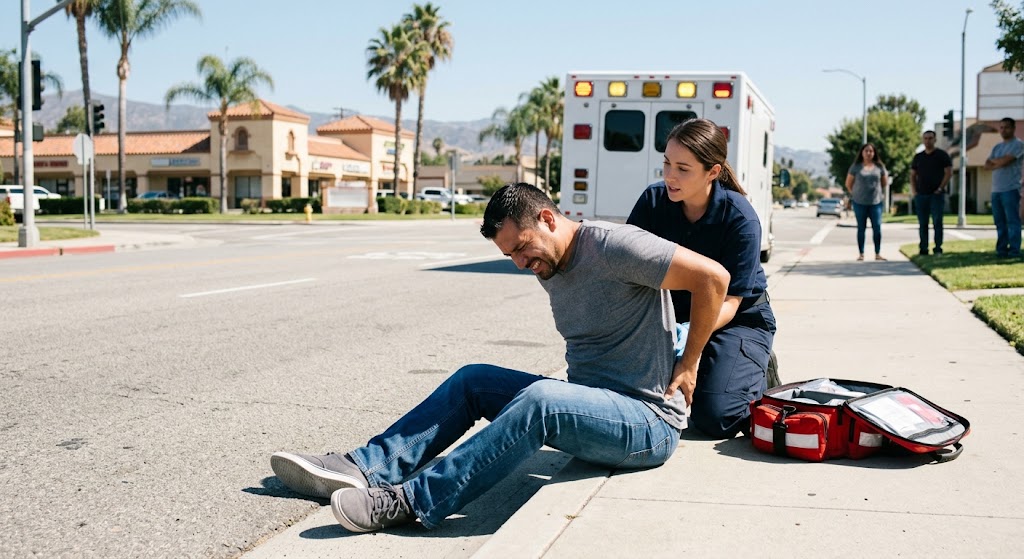
Back injuries are the most contested category in personal injury litigation, and not because they are minor. It is because almost every adult over 35 shows some degenerative change on an MRI, and insurers use that to argue the accident changed nothing.
In West Covina these injuries come from rear-end collisions in I-10 congestion, broadside impacts at Azusa Avenue and Vincent Avenue intersections, lifting injuries in the warehouse, retail and distribution work that employs a large share of the San Gabriel Valley workforce, falls at commercial properties, and construction and work zone incidents. Djougourian Law Corp knows how to prove these cases.
Understanding Back Injuries
The spine has 33 vertebrae across cervical, thoracic, lumbar, sacral and coccygeal regions. Discs absorb load, facet joints guide motion, ligaments stabilize and muscles support. Nerve roots exit at each level and control specific territories in the legs and feet.
The National Institute of Neurological Disorders and Stroke notes that back pain is among the most common medical complaints in the United States, and the Bureau of Labor Statistics consistently identifies back injuries among the most frequent and costly workplace injuries.
Common diagnoses after a West Covina accident:
Herniated lumbar disc. Nucleus material extrudes through a tear in the annulus and contacts a nerve root, producing radiating pain, numbness and weakness in the leg. L4-L5 and L5-S1 are the most frequently involved levels.
Vertebral fracture. Compression and burst fractures from axial loading in falls and higher-energy collisions. Some heal with bracing, others require fusion or kyphoplasty.
Soft tissue injury. Muscle strain and ligament sprain, which can resolve or become chronic.
Facet joint injury. Inflammation and cartilage damage in the posterior joints, a frequent source of persistent axial back pain.
Spinal stenosis and spondylolisthesis. Canal narrowing and vertebral slippage that trauma can render symptomatic.
Sacroiliac joint dysfunction. Often missed initially and frequently disabling.
How These Injuries Happen Locally
Rear-end and broadside collisions on I-10, SR-60, Azusa Avenue, Vincent Avenue, Amar Road and Sunset Avenue. Lifting and material handling in warehousing, distribution and retail across the valley. Falls from height and struck-by incidents on construction and work zone sites. Slip and fall landings on stairs, curbs and parking lot surfaces. Repetitive strain in trades, logistics and healthcare work.
The Degeneration Defense, and How We Answer It
Expect the defense to point at your MRI and say the findings are age-related. Here is what actually resolves the question:
Pre-accident records. If you had no back complaints in your medical history before the collision, that absence is powerful.
Symptom onset timing. Documented onset in the hours and days after the event connects mechanism to injury.
Imaging interpretation. A radiologist and treating surgeon can distinguish acute findings such as annular tears, edema and Modic changes from chronic degenerative appearance.
The eggshell plaintiff rule. California law is settled: a defendant takes the plaintiff as they find them. If a pre-existing condition made you more vulnerable, or the accident aggravated a condition that had been asymptomatic, the defendant is responsible for the full extent of the harm caused. CACI 3927 instructs juries on aggravation of pre-existing conditions.
Treatment Pathway
Most cases begin conservatively with activity modification, anti-inflammatories, muscle relaxants and physical therapy. When symptoms persist, interventional pain management follows: epidural steroid injections, medial branch blocks and radiofrequency ablation. Surgery, whether microdiscectomy, laminectomy or fusion, is reserved for structural problems conservative care cannot resolve, and it carries its own recovery arc and long-term consequences.
We make sure the record reflects the full course, including the treatment you will still need in ten years.
Frequently Asked Questions
What should I do after a back injury?
Get evaluated promptly even if you think you just tweaked it. Follow the treatment plan, and document how the injury affects work and daily activities. Gaps in treatment are the single most common thing insurers use against a back claim.
Can I recover if I had prior back problems?
Yes. Aggravation of a pre-existing condition is compensable. What matters is the difference between your condition before and after.
What if it happened at work?
Workers’ compensation covers medical care and partial wages, while a third-party claim against a non-employer defendant provides full damages including pain and suffering. See our construction accident page.
Will I need surgery?
Most people do not. That decision belongs to you and your surgeon, not to the insurer and not to us.
What is my case worth?
It depends on the diagnosis, the treatment required, whether you can return to your occupation and the permanence of the impairment. A documented disc herniation requiring injections or surgery is valued very differently from an unremarkable strain.
What if I cannot return to my job?
Diminished earning capacity is a recoverable element of damages, and for a worker in the trades or in warehousing it is often the largest single component of the claim.
Contact a West Covina Back Injury Attorney
Call 818-530-0000 or request a free consultation. No fee unless we win.


