

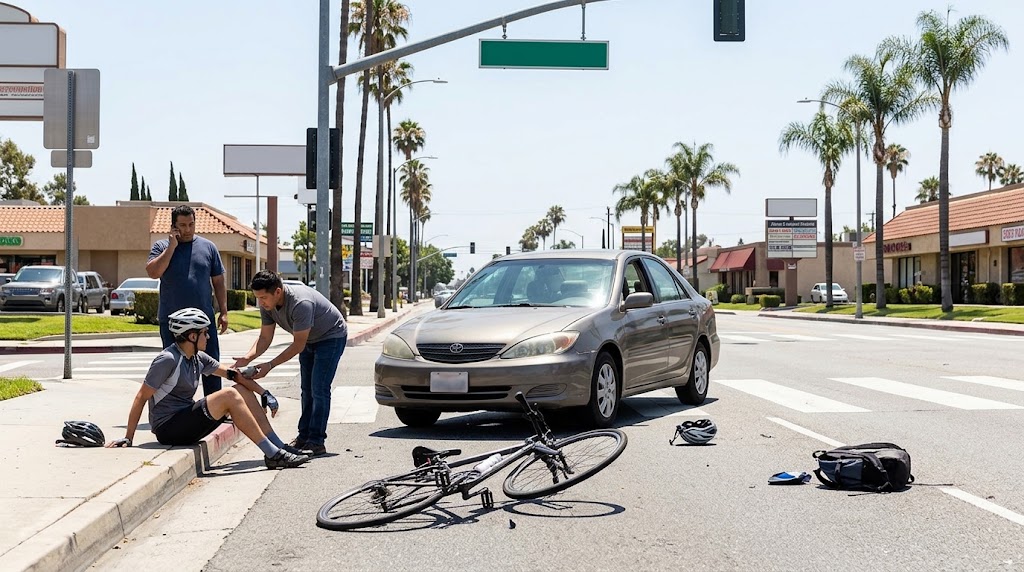
Cycling in West Covina means sharing wide, fast arterials with drivers whose attention is on the next freeway ramp. Residents ride to work, to the Metrolink and transit connections, to Cortez Park, Galster Park and Shadow Oak Park, and along the quieter residential grid north of Cameron Avenue. Riders also use the city as a route toward the San Gabriel River Trail and the foothill communities beyond.
The conflict points are predictable: driveway entrances along the Azusa Avenue retail corridor, right-turn pockets at major intersections, and the stretches where a bike lane disappears into a merge. Djougourian Law Corp has recovered $100,000 in a bike accident case and represents cyclists injured by driver negligence throughout Los Angeles County.
Cyclists Have the Same Rights as Drivers
California Vehicle Code Section 21200 gives a person riding a bicycle on a roadway all the rights and duties of the driver of a vehicle. A cyclist is not a guest on the road.
Two statutes carry most of the weight in these cases:
- Vehicle Code Section 21760, the Three Feet for Safety Act, requires a driver overtaking a bicycle to pass at a safe distance, and where three feet is not possible, to slow to a reasonable speed and pass only when it will not endanger the cyclist.
- Vehicle Code Section 22517 prohibits opening a vehicle door into moving traffic. This is the statute behind every dooring case.
Nationally, NHTSA reports hundreds of cyclist deaths and tens of thousands of injuries each year, with most fatal crashes occurring in urban areas.
Common Causes of Bicycle Accidents in West Covina
Right hooks. A driver passes a cyclist and immediately turns right across their path. This happens constantly at the commercial driveways along Azusa Avenue, Vincent Avenue and Glendora Avenue, and at freeway on-ramp approaches.
Left crosses. A driver turning left fails to yield to an oncoming cyclist, misjudging speed or not registering the rider at all.
Unsafe passing. Drivers squeezing past where the shoulder narrows on Amar Road, Cameron Avenue and the older sections of Citrus Street.
Failure to yield at driveways and parking lot exits. Retail center exits along the Azusa Avenue corridor have poor sight lines and drivers watching for a gap in car traffic, not for a bicycle.
Dooring, along street-parked blocks in the older commercial grid and residential areas.
Distracted driving. A cyclist’s narrow visual profile is the first thing a distracted driver fails to process.
Pavement defects and debris. Potholes, utility cuts, expansion joints and construction plates. Claims against a public entity for a dangerous roadway condition are subject to the six-month written claim requirement under Government Code Section 911.2.
Common Cyclist Injuries
Head and brain injury including concussion and more serious TBI. Clavicle, wrist, scaphoid, rib and hip fractures. Road rash requiring debridement and grafting. Facial and dental trauma. Shoulder separations and rotator cuff tears. Internal injuries. Spinal injury. Lasting anxiety in traffic that ends a person’s riding entirely.
High-Risk Locations for Cyclists
- Azusa Avenue through the retail corridor and at Amar Road
- Vincent Avenue and Sunset Avenue near the I-10 ramps
- Amar Road east and west through the southern neighborhoods
- Cameron Avenue and Barranca Street
- Glendora Avenue and Citrus Street through the older commercial grid
- Merced Avenue and Francisquito Avenue
- Retail center driveways and ring roads at Plaza West Covina, Eastland Center and The Heights
- Park approaches at Cortez Park, Galster Park and Shadow Oak Park
Why Cyclists Need Representation
Insurers start from the assumption that the cyclist did something wrong: not visible, not in the bike lane, came out of nowhere. Establishing what actually happened takes work.
Statutory violations. Proving a Section 21760 or 22517 violation reframes the case decisively. Scene evidence. Sight lines, lane widths, bike lane striping, driveway geometry and available commercial surveillance footage, which is overwritten quickly. Bicycle and equipment evidence. Damage patterns and component failure help reconstruct impact direction and speed. Medical documentation. Cyclist injuries are routinely underdocumented in the emergency department, where visible abrasions dominate the chart while a shoulder injury or concussion goes unrecorded. Public entity claims. Where roadway maintenance failed, the six-month deadline runs fast.
Frequently Asked Questions
Do I have to wear a helmet in California?
Vehicle Code Section 21212 requires helmets for riders under 18. Adults are not required to wear one, though helmets substantially reduce head injury severity.
Can I still recover without a helmet?
Yes. It may be raised in comparative fault as to head injuries only, and it does not bar recovery.
Can cyclists ride on sidewalks in West Covina?
Sidewalk riding is governed by local ordinance rather than state law, so rules vary between cities. Check the City of West Covina municipal code for current requirements.
What about e-bikes and scooters?
Electric bicycles are classified by class under Vehicle Code Section 312.5. The negligence analysis against an at-fault driver is substantially the same.
What if the driver left the scene?
Report it immediately. The West Covina Police Department Traffic Unit investigates all hit-and-run collisions in the city. Your own uninsured motorist coverage may also apply, and auto policies frequently cover household members injured while cycling.
What if I was partly at fault?
California’s pure comparative fault rule reduces your recovery by your percentage of responsibility without eliminating it.
What compensation can I recover?
Medical expenses, lost income, diminished earning capacity, bicycle and equipment replacement, scarring, pain and suffering and emotional distress.
Contact a West Covina Bicycle Accident Attorney
You had every right to be on that road. Call 818-530-0000 or request a free consultation. No fee unless we win.


